Flow control is an important aspect of hydraulic system designs as it is used to regulate speed. Various types of flow control valves and other devices can be used which enables the speed of an actuator to be controlled by regulating the hydraulic system's flow rate.
Flow rate also determines rate of energy transfer at any given pressure. The two are related in that the actuator force multiplied by the distance through which it moves (stroke) equals the work done on the load. The energy transferred must also equal the work done. Actuator speed determines the rate of energy transfer (i.e., horsepower), and speed is thus a function of flow rate.
Directional control, on the other hand, does not deal primarily with energy control, but rather with directing the energy transfer system to the proper place in the system at the proper time. Directional control valves can be thought of as fluid switches that make the desired "contacts." That is, they direct the high-energy input stream to the actuator inlet and provide a return path for the lower-energy oil.
It is of little consequence to control the energy transfer of the system through pressure and flow controls if the flow stream does not arrive at the right place at the right time. Thus, a secondary function of directional control devices might be defined as the timing of cycle events. Because fluid flow often can be throttled in directional-control valves, some measure of flow rate or pressure control can also be achieved with them.
Different Types of Flow Measurement
Controlling flow of a hydraulic system does not necessarily mean regulating volume per unit of time from a valve. Flow rate can be specified three different ways, so it is important to be aware of how flow is to be specified or measured:
Because they control the quantity of fluid that flows through the valve per unit of time, the same control valves are used for all three types of flow rates.
Control of Flow Rate with Valves
There are eight types of flow control valves which are used most often in hydraulic circuits.
Orifices
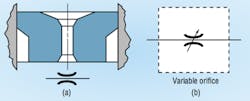
A simple orifice in the line, shown in Figure 1 (a) below, is the most elementary method for controlling flow. (Note that this is also a basic pressure control device.) When used to control flow, the orifice is placed in series with the pump. An orifice can be a drilled hole in a fitting, in which case it is fixed; or it may be a calibrated needle valve, in which case it functions as a variable orifice, Figure 1 (b). Both types are non-compensated flow control devices.
Flow Regulators
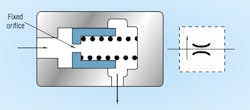
Flow regulators, shown in Figure 2 below, which are slightly more sophisticated than a fixed orifice, consist of an orifice that senses flow rate as a pressure drop across the orifice; a compensating piston adjusts to variations in inlet and outlet pressures. This compensating ability provides closer control of flow rate under varying pressure conditions. Control accuracy may be 5%, possibly less with specially calibrated valves that operate around a given flow-rate point.
Bypass Flow Regulators
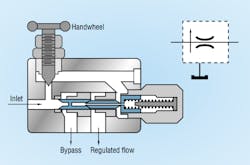
In bypass regulators, flow in excess of a set flow rate returns to the tank through a bypass port, Figure 3 below. Flow rate is controlled by throttling fluid across a variable orifice regulated by the compensator piston. The bypass flow regulator is more efficient than a standard flow regulator.
Demand-Compensated Flow Controls
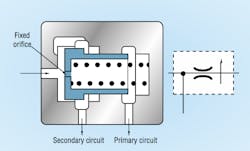
Flow controls can also bypass excess system flow to a secondary circuit using demand-compensated flow control valves as shown in Figure 4 below. Fluid is routed at a controlled flow rate to the primary circuit, and bypass fluid can be used for work functions in secondary circuits without affecting the primary one. There must be flow to the primary circuit for this type of valve to function – if the primary circuit is blocked, the valve will cut off flow to the secondary circuit.
Pressure-Compensated, Variable Flow Valves
Hydraulic flow can also be controlled using pressure-compensated, variable flow valves which are equipped with an adjustable variable orifice placed in series with a compensator. The compensator automatically adjusts to varying inlet and load pressures, maintaining an essentially constant flow rate under these operating conditions to an accuracy of 3-5%, as shown below in Figure 5.
Pressure-compensated, variable flow control valves are available with integral reverse-flow check valves (which allow fluid to flow unrestricted in the opposite direction) and integral overload relief valves (which route fluid to a tank when a maximum pressure is exceeded).
Pressure- and Temperature-Compensated, Variable Flow Valves
Because the viscosity of hydraulic oil varies with temperature (as do the clearances between a valve's moving parts), output of a flow control valve may tend to drift with temperature changes. Use of pressure- and temperature-compensated variable flow valves can overcome this.
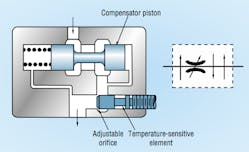
To offset the effects of such temperature variations, temperature compensators adjust the control orifice openings to correct the effects of viscosity changes caused by temperature fluctuations of the fluid, shown below in Figure 6. This is done in combination with adjustments to the control orifice for pressure changes as well.
Priority Valves
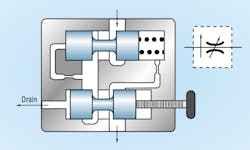
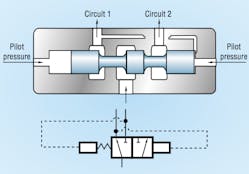
A priority valve, shown in Figure 7 below, is essentially a flow control valve that supplies fluid at a set flow rate to the primary circuit, thus functioning as a pressure-compensated flow control valve. Flow in excess of that required by the primary circuit bypasses to a secondary circuit at a pressure somewhat below that of the primary circuit. Should inlet or load pressure (or both) vary, the primary circuit has priority over the secondary – as far as supplying the design flow rate is concerned.
Deceleration Valves
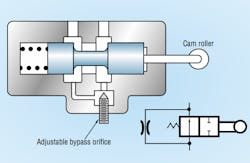
A deceleration valve, which can be seen below in Figure 8, is a modified 2-way, spring-offset, cam actuated valve used for decelerating a load driven by a cylinder. A cam attached to the cylinder rod or load closes the valve gradually. This provides a variable orifice that gradually increases backpressure in the cylinder as the valve closes. Some deceleration valves are pressure compensated.
READ MORE: Extrusion Press Hydraulic Valve Controls: The Right Time To Upgrade
Other Types of Flow Control Devices
There are various other types of flow control devices which can be used with hydraulic circuits as well.
Flow Dividers
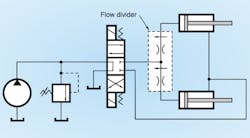
A flow divider valve is a form of pressure-compensated flow control valve that receives one input flow and splits it into two output flows. The valve can deliver equal flows in each stream or, if necessary, a predetermined ratio of flows. The circuit shown in Figure 9 below shows how a flow divider could be used to roughly synchronize two cylinders in a meter-in configuration.
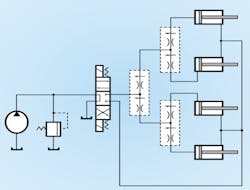
Like all pressure- and flow-control devices, flow dividers operate over a narrow bandwidth rather than at one set point. Thus, flow variations in the secondary branches are likely. Therefore, precise actuator synchronization cannot be achieved with a flow divider valve alone. Flow dividers can also be used in meter-out circuit configurations or cascaded – connected in series to control multiple actuator circuits, shown below in Figure 10.
Rotary Flow Dividers
Another technique for dividing one input flow into proportional, multiple-branch output flows is using a rotary flow divider. It consists of several hydraulic motors connected together mechanically by a common shaft. One input fluid stream is split into as many output streams as there are motor sections in the flow divider. Because all motor sections turn at the same speed, output stream flow rates are proportional and equal to the sum of displacements of all the motor sections. Rotary flow dividers can usually handle larger flows than flow divider valves.
The pressure drop across each motor section is relatively small because no energy is delivered to an external load, as is the usual case with a hydraulic motor. However, designers should be aware of pressure intensification generated by a rotary flow divider. If, for any reason, load pressure in one or more branches drops to some lower level or to zero, full differential pressure will be applied across the motor section in each particular branch. The sections thus pressurized will act as hydraulic motors and drive the remaining section(s) as a pump(s). This results in higher (intensified) pressure in these circuit branches.
When specifying rotary flow dividers, system designers must be careful to minimize the potential for pressure intensification. A pressure relief valve should be placed in any actuator fluid line where this condition may occur. Rotary flow dividers can also integrate multiple branch return flows into a single return flow.
Read more about flow dividers.
Proportional Flow-Control Valves
Proportional flow control valves combine state-of-the-art hydraulic valve actuation with modern, sophisticated electronic control. These valves help simplify hydraulic circuitry by reducing the number of components a system may require while, at the same time, substantially increasing system accuracy and efficiency.
An electronically controlled, proportional flow control valve modulates fluid flow in proportion to the input current it receives. The valves can easily control cylinders or smaller hydraulic motors in applications that require precise speed control or controlled acceleration or deceleration. Most proportional flow-control valves are pressure compensated to minimize flow variations caused by changes in inlet or outlet pressure.
An electrohydraulic proportional valve consists of three main elements:
- a pilot or proportional solenoid
- a metering area (where the valve spool is located), and
- an electronic position-feedback device, often an LVDT (linear variable differential transformer).
Valve operation begins when it receives a signal from an outside controlling device such as a computer, programmable logic controller (PLC), traditional logic relay, or potentiometer. The control device delivers analog electrical signals to the valve driver card, which, in turn, sends a current signal to the solenoid on the valve.
READ MORE: Electrohydraulic Valve Makes Forklift Fast, Nimble, and Efficient
The electromechanical force on the spool causes it to shift, gradually opening a flow path from the pump to the actuator port. The greater the command input signal, the greater the current to the valve solenoid, and, thus, the higher the flow from the valve. The important feature of this proportional valve is that all elements are proportional; thus, any change in input current changes force signals proportionately as well as the distance the valve spool will shift, the size of the flow path, the amount of fluid flowing through the valve, and finally the speed at which the actuator moves.
As the spool shifts, its motion is detected and monitored very accurately by an LVDT or other type of position-feedback transducer. This signal is fed back to the driver card where it is continuously compared with the input signals from the controller. If the two differ, the driver adjusts spool position until the two signals match.
Pressure-compensated proportional flow control valves are 2-port valves in which the main control orifice is adjusted electronically. Similar to conventional pressure-compensated flow control valves, a proportional version maintains constant flow output by keeping the pressure drop constant across the main control orifice. The proportional valve, however, is different in that the control orifice is modified to work in conjunction with a stroke controlled solenoid.
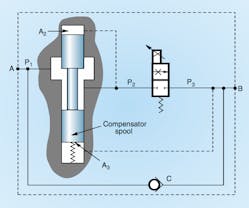
In a 2-port, pressure-compensated proportional flow control valve, an electrically adjustable control orifice is connected in series with a pressure reducing valve spool, known as a compensator, shown below in Figure 11. The compensator is located upstream of the main control orifice and is held open by a light spring. When there is no input signal to the solenoid, the light spring force holds the main control orifice closed. When the solenoid is energized, the solenoid pin acts directly on the control orifice, moving it downward against the spring to open the valve and allow oil to flow from port A to port B.
At the same time, the LVDT provides the necessary feedback to hold position. In this case, the LVDT provides feedback to maintain a very accurate orifice setting.
Pressure compensation is achieved by incorporating a pilot passage at the inlet of the valve that connects to one side of the compensator spool, A2. There is another pilot passage located near the outlet of the valve beyond the control orifice, and it is connected to the opposite side of the compensator spool, A3. A bias spring on this side of the spool keeps the compensator in the open position. Load-induced pressure at the outlet port — or pressure deviations at the inlet port — modulate the compensator spool to increase or decrease the pressure drop across the compensator's metering orifice. Acting as a pressure reducing valve, the compensator ensures that the main control orifice sees a constant pressure drop. When the pressure drop is constant, the flow remains constant.
The amplifier provides time controlled opening and closing of the orifice. For reverse free-flow, check valve C in Figure 11 above, built into the valve, provides a flow path from port B to A. Proportional flow control valves are also available with either linear or progressive flow characteristics. The input signal range is the same for both. However, the progressive flow characteristic gives finer control at the beginning of orifice adjustment.
In case electrical power or feedback is lost, solenoid force drops to zero and the force exerted by the spring closes the orifice. When feedback wiring is connected incorrectly or damaged, an LED indicates the malfunction on the amplifier card.
Proportional Flow Logic Valves
Proportional flow control logic valves are basically electrically adjustable flow controls that fit into a standard logic valve cavity. The cover and cartridge are assembled as a single unit, with the cover consisting of a proportional force solenoid and a pilot controller, shown in Figure 12 below.
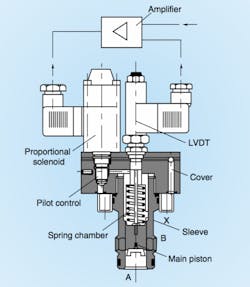
When an electrical signal is fed into an electronic amplifier, the solenoid and controller adjust the pilot pressure supplied from port A to change spool position. An LVDT then feeds back the position to the amplifier to maintain the desired orifice condition for flow from port A to port B. The proportional logic valve is available with either linear or progressive flow characteristics, and the valve drivers respond to voltage (0-10V DC) or current (0-20 mA) command signals. The typical valve amplifier card requires a 24V DC power supply.
Because the valve remains relatively unaffected by changes in system pressure, it can open and close the orifice in the same length of time. This maximum time can be changed on the amplifier card by adjusting a built-in ramp generator.
The amplifier can be used in several ways. An external electronic control can make the orifice remotely adjustable while maximum spool acceleration is still limited by this internal ramp; or a switch can be added to turn the ramp on and off. In case of power failure, the element will return to its normally closed position.
Determining the best type of flow control valve to use depends on the design parameters of the application. The table below provides general guidelines based on common application characteristics.
| Which Flow Control Valve to use for an Application | |
| Application | Type of Flow Control Valve |
|---|---|
| Load on the actuator and supply pressure both are constant: ±5% accuracy | Non-compensated, fixed or variable flow control, depending on application |
| Load on the actuator, supply pressure, or both undergo changes: ±3-5% accuracy | Pressure-compensated, fixed or variable flow control, depending on application |
| Load on the actuator, supply pressure, or both change, and fluid temperature varies ±30° F (±17° C): ±3-5% accuracy | Pressure- and temperature-compensated, fixed or variable flow control |