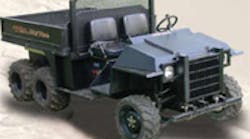
The patented HyVee Ox provides unmatched push-pull capability in comparison to its dimensional footprint and weight by virtue of its six-wheel hydrostatic drive. It’s not much bigger than a golf cart, yet it can tow more than 66,000 lb and carry a payload of 4000 lb — both at the same time. It can also scale a 15° slope while carrying or towing a full load. The Ox can do all this for indefinite periods without overheating, thanks to the innovative design of its powerful hydrostatic drive system.
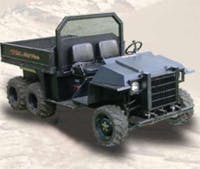
A tactical ground-support vehicle, the Ox is manufactured by HyVee Equipment LLC, Clarksville, Tenn. Its small size and light weight mean it can easily fit inside a medium helicopter. Yet, it has more than enough power to tow a CH-47 helicopter up an incline.
The Ox is nearly 4-ft shorter and almost 2-ft narrower than an HMMWV (Humvee). The Ox also weighs less — 3000 lb, as opposed to the Humvee’s 5700 lb — and the Ox’s towing capacity far exceeds the 8510 lb of a Humvee. However, the Ox is not intended to replace the Humvee but, rather, to augment it by performing tasks where a smaller, lighter vehicle is needed.
Power and versatility
The Ox’s hydrostatic drive system consists of a variable-displacement, axial-piston pump with reverse-flow capability from Sauer Danfoss, Ames, Iowa. Each of the Ox’s six wheels is driven by a high-torque HB wheel motor from White Drive Products, Hopkinsville, Ky. The pump, capable of 50 gpm at 4500 psig, was chosen for its combination of performance and reliability for the money. The wheel motors, each sized at 25 in.3/ rev, were chosen because of their high torque capability, smooth rotational output at low speeds, and low internal leakage, which translates to high volumetric efficiency. Their low-speed, high-torque output eliminates the need for an auxiliary gearbox, which provides a lighter, more compact, and simpler wheel drive.
But what makes the Ox achieve its efficient and effective high-torque drive is its hydraulic circuitry that switches the wheel drive motors between parallel flow (low-speed, high-torque mode) and series flow (high-speed, low-torque mode). This is accomplished using a pair of directional control valves and two rotary flow dividers, as shown in the schematic.
Achieving the improbable
The illustration shows a simplified schematic of the Ox’s hydraulic system. It is shown in its zero state, at-rest mode. In this mode, the pump is at zero displacement, but once the pump’s displacement control moves off center, the Ox will be in its low-speed, high torque mode.
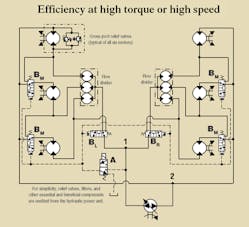
In the low-speed forward mode, fluid flows from the left side of the bidirectional pump to junction 1, between valves BL and BR. Line pressure is also transmitted to solenoid valve A. However, because valve A is closed, pilot pressure is not transmitted to any downstream components.
From the junction, fluid flows to valves BL and BR. But because neither valve receives pilot pressure from valve A, they remain in their de-energized state, so they route fluid up to their respective rotary flow divider.
Each rotary flow divider is a Roller Stator flow divider from White Drive Products and is essentially made up of three 18-in.3 hydraulic motors with a common shaft. So fluid entering the flow divider assembly flows into all three motors and turns the common shaft, which causes all three to rotate at exactly the same speed. Therefore, flow from each of the three outlet ports of the flow divider is 13 that of the flow entering the single inlet port. This establishes the flow divider as a meter-in device, ensuring that all three motors rotate at the same speed.
From the flow divider, an equal amount of fluid flows into each wheel motor, so each rotates at the same speed. The flow dividers ensure that each motor receives 16 of pump flow — half of pump flow goes through valve BL, half goes through BR, and each flow divider sends 13 of the flow it receives (half of total flow) to each wheel motor.
However, each wheel motor has full pump pressure available — at least theoretically — so it is capable of high torque. Fluid exiting each motor flows back to the pump either directly or through valve BM. This establishes a parallel flow circuit for each of the two sets of motors.
Switching modes
To switch the Ox into its highspeed, low-torque mode, the operator activates a switch that energizes the solenoid of valve A. The solenoid opens valve A, so pilot pressure now is transmitted to valves BL, BR, and each motor valve BM. With valves BL and BR shifted, fluid now flows directly to the bottom motors in the schematic.
However, because valve BM receives pilot pressure, it has shifted, so fluid no longer flows back to the hydrostatic pump. Instead, fluid flows from the bottom motors to the middle ones. Likewise, fluid exiting the middle motors flows into the top ones. Finally, fluid leaving the top motors returns to the pump.
This single flow stream through each pair of three motors establishes a series motor circuit. Each motor receives half of pump flow from valve BL or BR, which provides high-speed capability. Pressure capability, however, is now shared by three motors on either side of the machine. So the motors operate in a high-speed, lowtorque mode.
Reversing the order
Switching the Ox into reverse is accomplished through the pump’s displacement control. For the Ox, this is done by providing a lever that the operator shifts. Doing so essentially reverses the polarity of the signal from the accelerator pedal’s position transducer to the pump’s displacement control, which controls position of the pump’s swashplate.
Hydraulic flow in the reverse mode again can be seen in the schematic. If the Ox is in its low-speed, high-torque mode, valve A is not energized, so pilot pressure is not transmitted to valves BL, BR, and BM. Fluid flows from the right side of the pump to junction 2. Flow splits at this junction and travels around to the three motors on the left and three on the right. Fluid flows into the two lower motors through their respective valve BM and directly into the upper motors. Exiting the motors, fluid then flows into the respective flow divider.
Fluid from the lower motors cannot flow through valve BL or BR because they are closed, by virtue of no pilot pressure. From the flow divider, fluid combines at junction 1 and flows to the left side of the pump. In this configuration, each flow divider acts as a meter-out device — again ensuring that all three motors rotate at the same speed.
When in the high-speed, lowtorque mode in reverse, the operator activates the lever for high-speed operation, so valve A opens to route pilot pressure to valves BL, BR, and BM. The pilot pressure shifts the valves, so fluid can no longer flow through all six motors in parallel. Instead, fluid flows past the bottom and middle motors and enters the top motors. From there, fluid flows into the middle motors through valve BM, then to the bottom motors through their respective valve BM.
After exiting the bottom motors, fluid cannot flow into the flow dividers because valves BL and BR, have shifted to block flow from them. Instead, fluid exits the bottom motors and flows through valves BL and BR, and, finally, into the left side of the pump.
Design considerations
As with any system design, decisions had to be made based on reliability, performance, efficiency, cost, and practicality. For example, all valves could be solenoid operated instead of pilot operated. However, designers deemed pilot-operated valves more reliable for this application. Pilot actuated valves are more tolerant of fluid contamination than solenoid valves are, and electrical actuation is sensitive to corrosion and malfunctions from contact with water. Pilot lines are also less likely to be damaged from unpredictable environmental conditions.
Another consideration was the choice for valves BL and BR. A larger, single valve could have been used. However, designer’s found smaller valves to be more readily available — which would be important if a replacement was needed — and also less costly. Moreover, by using two smaller valves, the BL and BR valves are the same as the BM valves. This simplifies inventory and eases maintenance by consolidating part numbers.
The flow dividers also required careful consideration. The first choice was between rotary and valve-type flow dividers. However, because they split flow mechanically instead of using energy-wasting orifices, rotary flow dividers are much more energy efficient than their valve-type counterparts, so rotary flow dividers were chosen.
Another consideration was the number of flow dividers to use. Designers quickly settled on two 3-outlet flow dividers based on cost, practicality, and because the two flow-divider system provides a split power train, which operators and technicians would be familiar with.
Because speed, direction, and driving mode all lend themselves to electrohydraulic control, the HyVee Ox could’ve been fitted with, say, a multi-axis joystick for single-point control. However, because the Ox was developed for military applications, designers wanted it to use conventional type controls. Therefore, speed is controlled with a foot pedal coupled with an electronic transducer that sends a signal to the pump’s displacement control. So as the operator presses farther on the accelerator pedal, pump displacement increases, which increases vehicle speed.
Forward and reverse is controlled through a lever similar to that used in conventional transmissions. Pivoting the lever to the reverse position changes the polarity of the signal from the accelerator pedal transducer. So pushing on the pedal increases speed in the reverse direction.
The Ox is also shifted out of and into low-speed, high-torque using a lever-activated switch. This switch is normally open (de-energized), so it does not send a signal to solenoid valve A unless the operator throws the lever into the high-speed mode. An interlock is also provided to prevent the vehicle from starting while in the high-speed mode.
The Ox gives the operator a choice of two speed ranges — a low-speed, high-torque mode and a high-speed, low-torque mode for road speeds to 40 mph or higher. Each of the Ox’s two flow dividers is a Rotary Drive Roller Stator design from White Drive Products.
Another consideration was the 3:1 torque-speed range. If the HyVee Ox requires only a 2:1 range, it can be fitted with a regenerative circuit that uses one 4-outlet flow divider. A description of this circuit appears in the December 2007 issue of Hydraulics & Pneumatics; click here to view the article in a new window.
Other applications
This system was first applied, under license from HyVee, by Mark Perry, Fitzsimmons Hydraulics, Clarence, N. Y., in a crop harvester. The machine often must operate in deep mud, so high torque at low speed is necessary to propel the vehicle through this challenging terrain. In its low-speed mode, it runs at a harvesting speed of 300 ft/hr (1 in./sec). It can be shifted to a high-speed mode for traversing between fields at 4 mph. This keeps the pump and the motors operating efficiently in both speed ranges. The harvester uses Sauer-Danfoss OMS 12 in.3/rev hydraulic motors coupled with 30:1 Power Wheels.
But flow divider circuits are not limited to mobile applications; similar circuits using flow dividers could also be applied to hydraulic conveyor drives. The flow dividers would ensure that each conveyor motor runs at the same speed, and the conveyor would run efficiently whether lightly loaded or fully loaded.
The Ox in action
The Ox, due to the combination of the Sauer-Danfoss variable-disare placement axial-piston pump with the White Drive’s HB motors, has exceptional control and smooth operation, pushing or pulling loads, without jerk, from dead stop all the way through its operating range, making it ideally suited to moving sensitive loads such as ammunition, explosives, and aircraft where precise movement control is required, especially when loading sensitive loads into an aircraft, up a ramp, or even towing an aircraft up a ship loading ramp.
Twenty five HyVee Ox vehicles are currently in use at the U. S. Army’s Aviation Center, Ft. Rucker, Ala. These are standard models, specifically designed for airfield use with a custom 28-V, 3000-A aircraft jumpstart system integrated within the vehicle. Later models have off-road capability with no loss of torque. The integral hydraulic power system can be used to power an integrated dump bed and accessories, such as auxiliary power, winches, power tools, lifts, booms, fire fighting and snow removal equipment, and construction accessories. Its 4000- to 6000-lb payload capacity accommodates water or fuel tanks.
The Ox also can be used to move, place, and displace towed howitzers, mortars, supporting ordinance where deployment of heavy prime movers is restricted. The Ox is a prime candidate for special purpose aviation units, such as carrying ordinance and offset heavy mortars, increasing safety for crew and aircraft.
Lastly, the Ox is suitable for natural disaster environments or an urban warfare environment where an easily deployable, durable, small wheel or track vehicle can be useful even in mundane tasks, such as placing and removing barricades, moving damaged vehicles and equipment, or moving debris from flood and earthquake zones. The powerful, easily deployable OX reduces manpower requirements for a wide variety of combat, and combat support tasks, including use as a litter carrier.
The HyVee Ox has performed successfully in Afghanistan, Iraq, and various locations by Special Operations tasking. It passed the test of operations in dusty conditions where temperatures reached 165° F. The Ox can easily fit inside medium lift helicopters as well as any fixed wing transport that would accommodate the discontinued M151 vehicle.
George Morgan, P. E., is a registered patent agent with Morgan & Associates. He can be reached at (812) 476-4065 or by e-mail at [email protected] . Bud Trinkel, deceased, was a fluid power consultant when this article was originally published.