In February 1976, producer Dino De Laurentiis was one month into the shooting schedule for King Kong when the engineering firm bidding to build the giant ape informed him that, using an electromechanical system, would require five months to build a small prototype model, and an additional year to scale it up to its final size. And De Laurentiis had to release the film in December, 1976, less than 11 months in the future!
Glen Robinson, MGM's chief of special effects on loan to De Laurentiis came up with the answer. "We can do it in four months. But you'll have to let me do it my way — with hydraulics."
With an estimated cost of $500,000, De Laurentiis gave the go ahead. Robinson, his special effects foreman Joe Day, layout foreman Jimmy Thomson, and a host of welders and hydraulic mechanics were on their own.
No time for circuit diagrams
Considering the tight time schedule they faced, there was no time for designing the circuits first on paper. Based on anatomical sketches by Italian sculptor-engineer-designer Carlo Rambaldi, King Kong's hydraulic systems were breadboarded directly on the floor of a cleared section of MGM's construction shop.
"If we had relied on engineering drawings, we really would have been in a bind because we had to change the size of Kong three times," Robinson said.
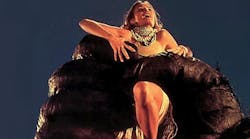
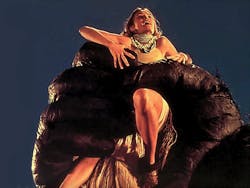
Breadboarding was well on the way for a 35-ft ape when it was discovered that leading lady Jessica Lange, who plays Dwan, could not snuggle safely in the palm of a 6-ft, 2-in. hand. The hand was reworked to a span of 6 ft, 10 in., and in proportioning, King Kong grew first to 48 ft, then shrank to 42 ft.
With no engineering drawings, the practical experience and inventiveness of Robinson and his crew were of prime importance. Because there was no time to order custom cylinders, they used standard cylinders, tested them in assembly, and then improvised if something didn't work right.
For example, there was danger at one point that the cylinders that animate King Kong's hand might over stroke and cause the ape's fingers to crush his leading lady in his palm. To overcome this problem, they incorporated positive stops into each cylinder that shortened the stroke of each finger cylinder and stopped piston travel at a precisely measured point. They could have used conventional external control valves to limit piston travel, but that would have meant adding equipment that might fail— something the leading lady wouldn't like!
The stops were simple, failsafe, and quickly made in the machine shop. They machined a brass cylindrical "plug" to fit the ID of the ¾-in. bore by 2-in. stroke finger cylinders. The plug was drilled with a center hole through which the piston rod passed. Axial holes provided free flow of fluid inside, Figure 1.
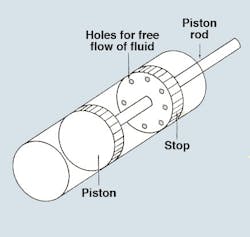
Each plug was then cut to the exact length to accommodate various piston strokes. When installed in the cylinder, there was no way the piston could travel beyond the positive stop.
Success of the design was demonstrated during an early set-up scene with stunt woman Sunny Woods substituting for Jessica Lange. As Kong's huge arm lifter her into the air, a ¼-in. wrist cable failed. The hand suddenly drooped limply from the wrist, swinging her abruptly from a vertical to a horizontal position. But the stops held the fingers in position, neither crushing her, nor permitting her to fall.
Proportional valves control motion
Cylinders in Kong's hand varied in size from a ¾-in. bore by 2-in. stroke for his fingers, to those with 4-in. bores and 3-ft strokes to flex his 4½-ft diameter, 20-ft-long arms. Remotely controlling these cylinders was to present an equally serious challenge.
Whatever made Glen Robinson, who is chief of special effects in MGM Studios in Culver City, think that he could do what a high-priced mechanical engineering firm had said would take three times as long and much more money to accomplish?
The first thought was to put a special effects man in an ape suit (to be used for some location shots) and outfit him with potentiometers that would be wired to proportional valves controlling the big ape's cylinders. As the actor would move inside the suit, the big Kong would duplicate his movements exactly.
But suppose that while Jessica Lange was in the big hand, the man in the suit sneezed and flung his hand up toward his nose? "We could just imagine the big ape doing the same," said Robinson, "sending the female star flying over his shoulder and into the rafters of the stage!"
They then decided to use manual remote control boxes, one for each cylinder, manned by carefully rehearsed operators. However, there were still problems.
Applying a variable electrical input signal to a proportional control valve controls only cylinder speed, not its final position. In addition, the 30% deadband in the standard proportional control valves they were using caused a delay before the valve spool shifted far enough to actuate the cylinder. This delay meant that the ape would not respond quickly enough when director John Guillermin called for a certain action, and the scene would be ruined.
Master special effects man puts life in King Kong
"After forty or so years of using hydraulics for all kinds of crazy special effects, you can get a pretty good feel for what you can do," Robinson said. "At MGM, we began using hydraulics back in 1934, when we filmed Broadway Melody."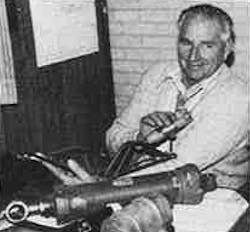
Among the jobs he's done hydraulically was that of making it possible for city-bred extras to sweep the backbreaking oars of Roman slave galleon.
"The Roman Empire could have ruled the seas if they'd had what we cooked up in filming Ben Hur - the first slave galleons ever rowed with hydraulic assists on every oar, and hydraulics keeping the oars sweeping in perfect unison!" laughs Robinson.
In the photo, Robinson holds a jointed frame for massive Kong finger, and indicates location of using actuating hydraulic cylinder. Cylinders on the desk show different sizes needed for various parts of Kong's anatomy.
Editor's Note: As this article was being written, we learned that the special effects in King Kong and Logan's Run (which was also shot at MGM) were voted Special Acheivement Awards by the Academy of Motion Picture Arts and Sciences. This makes Robinson eligible for his third Oscar. He previously won for special effects in Hindenburg and Earthquake.
Sandard valves modified for special control
Robinson got what he needed with innovations that show promise of finding their way into a variety of industrial hydraulic systems. To control the cylinder's position accurately along its stroke, his team attached a small rack on the cylinder rod, Figure 2. The rack engages a pinion gear to position the sweep of a feedback potentiometer as the rod extends or retracts.
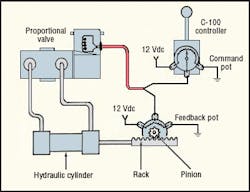
Voltage from the feedback pot passes to the proportional valve, as does voltage from the command pot in the manual controlled. When the voltage of the command pot in the control box equals the voltage on the driven pot, the proportional valve shifts and blocks fluid flow to the cylinder.
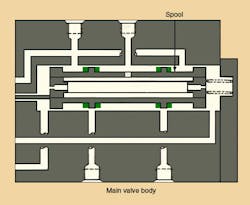
The problem of deadband lag was resolved by Ernie Escobar, of SLI Industries, by removing 0.030 in. from the width of the spool lands at the input and output ports, Figure 3. Reworking the valve spool was the key: it reduced the deadband to zero and eliminated any time lag between remote control commands and Kong's responses. When the control operators moved levers to order Kong to caress Dwan, he did so instantly, creating the illusion of a living creature on screen.
Aside from these modifications, Kong's hydraulic system was made with off-the-shelf components, put together in a hurry with products from nearby distributors and manufacturers.
All hydraulic components were rated for 3000 psi because Robinson and his staff wanted to be sure they had all the power they needed. As it turned out, they over-specified, because Kong behaved perfectly operating at pressures to only 1200 psi supplied by pumps delivering flows from 15 to 35 gpm.
"Our Kong is full functional", Robinson said, "He wiggles his arms, turns his head, twitches his ears, rolls his eyes, bends both legs, pulls his mouth back to show his gums, rotates on his hips, thrusts out his legs, and, when he has to, smiles.” All hydraulically.
"He really frightens you, he is so thoroughly alive," reminisces Robinson, "even when you realize he is only eight tons of hydraulic animation, latex skin, horsetail hair hide (1012 lb of it), and 3½ tons of aluminum framework."
Kong preformed with minimal time out to repair frame breakage and fluid leaks. The leaks were often caused by a technician in a hurry, who had not properly tightened a hydraulic connection.
Cost-saving as well as time-saving
What did it cost to animate King Kong with hydraulics? Even with the job completed, Robinson can only estimate.
"But," he told us, "it was only a fraction of the cost of electromechanical animation. You can begin to get some idea from our having Kong ready for the cameras in less than five months, compared to the year-and-one-half estimated for the electromechanical proposal."
"I had told De Laurentiis we probably could do the bare-frame hydraulics and aluminum tube skeleton for around $500,000. Adding two extra arms (for close-up, interior camera shots, see box), and the hydraulic pumps, which were exterior to the studio to avoid noise pickup, and renting cranes to lift the extra arms and erect the big ape, the total possibly went to $800,000 — still several times less than the cost of the electromechanical animation.
"We started with a budged of $1.5 million for all special effects, excluding the animated Kong. Only an auditor's accounting could verify it, but I've been told that we wound up with a budget surplus of about $385,000."
This article was originally published in the April 1977 issue of Hydraulics & Pneumatics. It is reprinted here for its historical and archival value.
Click here to see the theatrical trailer, which shows footage of the electrohydraulic Kong and the electrohydraulic hand that clutches and appears to lift Jessica Lange.
How do you animate a 42-foot, 11½-ton hairy ape?
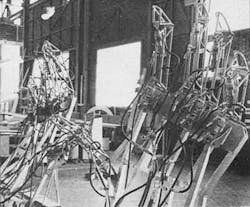
After Dino De Laurentiis gave the go ahead for Glen Robinson and his crew to build a hydraulically animated ape, they set out to create King Kong. Four-and-one-half months later, Kong was erect, on the set, and ready to perform — a mere half hour before filming. At director Guillermin's commands, the huge Kong instantly and smoothly raised his hands 55 ft into the air; blinked his eyelids; moved his eyes to "focus" on the object of his gaze; and curled or uncurled his 8-in. diameter fingers. Cylinders moved aluminum plates in his chest to make him "breathe".
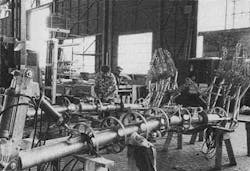
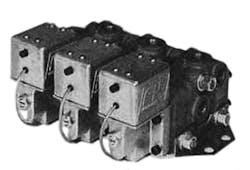
Hidden within his hairy figure were hydraulic muscles and their commanding nerves — 140 hydraulic cylinders; 84 remotely-controlled proportional valves (stacked 16 high in his belly); two hydraulic motors to turn his wrists and arms; 150 potentiometers; and 3100 ft of hydraulic hose, with as many feet of remote control electrical wiring. To operate the extra pair of arms for detail shots, there were: 50 cylinders; 34 proportional valves; two hydraulic pumps and motors each; potentiometers for each cylinder and motor; and hundreds of feet of hydraulic hose and electrical wiring.
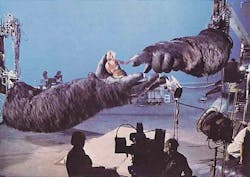
For remote control of each animating cylinder and motor, nearby benches were arrayed with 150 manual control boxes and their actuating levers, manned by as many operators as were needed for a particular scene. Each control box included its own potentiometer to sense control lever position, and to electrically transmit it to the remote proportional valve commanding the related hydraulic cylinder or motor. The photos in this box show some of the stages in construction of the giant King Kong.