
Valve building blocks

Spool-type valves are widely used because they can be shifted to two, three, or more positions for routing fluid between different combinations of inlet and outlet ports. They are used extensively for directional control of actuators because a single valve can produce extension, retraction, and neutral of a cylinder or forward, reverse, and neutral of a motor.
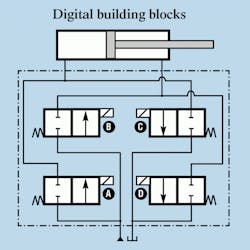
However, these same functions can be accomplished with digital valves. The illustration shows four normally closed (NC) valves grouped into a hydraulic integrated circuit to provide the same functionality as a 3-position spool valve. With all valves in the neutral condition, as shown, fluid flow to and from the pump, reservoir, and actuator is blocked.

Energizing solenoid A routes pressurized fluid to the cap end of the cylinder, causing the rod to extend. Simultaneously energizing solenoid D routes fluid from the cylinder’s rod end to tank. In similar manner, energizing only solenoids B and C causes the rod to retract and routes fluid from the cylinder’s cap end to tank.

The valves in the figure at right are arranged to function as a 3-position closed-center spool valve. An open-center valve could be achieved simply by making all the digital valves normally open (NO) instead of normally closed. Likewise, tandem- and float-center configurations can be accomplished by using various combinations and placement of NO and NC digital valves.

An advantage of digital valves over spool valves is that digital valves use a poppet or plunger, so no cross-port leakage occurs. A limitation is that they cannot provide the proportional control of spool valves. However, acceleration and deceleration ramps can be achieved by using soft-shift valves.

Discuss this Article 2

Brian Falconer (not verified)
on Feb 28, 2013

There is a danger here that if solenoid D fails to energise then there will be pressure intensification in this part of the circuit leading to either damage to the system or worst case damage to personnel. Have seen this with faulty faulty quick release couplings on agri machinery

Alan Hitchcox
on Mar 16, 2013

Good point, Brian, and thanks for the tip.
I suppose you could make valve D pilot assisted. This would open the valve without the solenoid if line pressure exceeded max operating pressure. Or you could place relief port between the cylinder's rod end port and valve D.

Post new comment
Sign In or register to use your Hydraulics & Pneumatics ID
(optional)
New blog posts

Subscribe to the Hydraulics & Pneumatics Newsletter!

Keep up with the latest news with our newsletter

Hydraulics & Pneumatics Bookstore

Our online bookstore features most of the industry’s most popular and classic technical training books available.  

Click below to browse the bookshelves today!

Follow Us