Download this article in .PDF format
Accumulators usually are installed in hydraulic systems to store energy and to smooth out pulsations. Typically, a hydraulic system with an accumulator can use a smaller pump because the accumulator stores energy from the pump during periods of low demand. This energy is available for instantaneous use, released upon demand at a rate many times greater than what could be supplied by the pump alone.
Accumulators also can act as surge or pulsation absorbers, much as an air dome is used on pulsating piston or rotary pumps. Accumulators will cushion hydraulic hammer, reducing shocks caused by rapid operation or sudden starting and stopping of power cylinders in a hydraulic circuit.
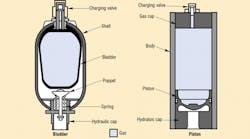
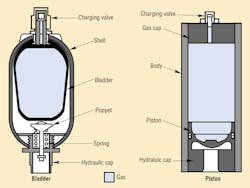
There are four principal types of accumulators: the weight-loaded piston type, diaphragm (or bladder) type, spring type, and the hydro-pneumatic piston type. The weight-loaded type was the first used, but is much larger and heavier for its capacity than the modern piston and bladder types. Both weighted and spring types are infrequently found today. Hydro-pneumatic accumulators, Figure 1, are the type most commonly used in industry.
Functions
Energy storage — Hydropneumatic accumulators incorporate a gas in conjunction with a hydraulic fluid. The fluid has little dynamic power-storage qualities; typical hydraulic fluids can be reduced in volume by only about 1.7% under a pressure of 5,000 psi. (However, this relative incompressibility makes them ideal for power transmission, providing quick response to power demand.) Therefore, when only 2% of the total contained volume is released, the pressure of the remaining oil in the system drops to zero.
On the other hand, gas, the partner to the hydraulic fluid in the accumulator, can be compressed into small volumes at high pressures. Potential energy is stored in the compressed gas to be released upon demand. Such energy can be compared to that of a raised pile driver ready to transfer its tremendous energy upon the pile. In the piston type accumulator, the energy in the compressed gas exerts pressure against the piston separating the gas and hydraulic fluid. The piston in turn, forces the fluid from the cylinder into the system and to the location where useful work will be accomplished.
Pulsation absorption - Pumps, of course, generate the required power to be used or stored in a hydraulic system. Many pumps deliver this power in a pulsating flow. The piston pump, commonly used for its high pressure capability, can produce pulsations detrimental to a high-pressure system. An accumulator properly located in the system will substantially cushion these pressure variations.
Shock cushioning - In many fluid power applications, the driven member of the hydraulic system stops suddenly, creating a pressure wave that travels back through the system. This shock wave can develop peak pressures several times greater than normal working pressures. It can cause objectionable noise or even system failure. An accumulator's gas cushion, properly located in the system, will minimize this shock.
An example of this application is the absorption of shock caused by suddenly stopping the loading bucket on a hydraulic front end loader. Without an accumulator, the bucket, weighing over 2 tons, can completely lift the rear wheels of a loader off the ground. The severe shock to the tractor frame and axle, as well as operator wear and tear, is overcome by adding an adequate accumulator to the hydraulic system.
Supplementing pump flow - An accumulator, capable of storing power can supplement the hydraulic pump in delivering power to the system. The pump stores potential energy in the accumulator during idle periods of the work cycle. The accumulator transfers this reserve power back to the system when the cycle requires emergency or peak power. This enables a system to utilize a much smaller pump, resulting in savings in cost and power.
Maintaining pressure - Pressure changes occur in a hydraulic system when the liquid is subjected to rising or falling temperatures. Also, there may be pressure drop due to leakage of hydraulic fluid. An accumulator compensates for such pressure changes by delivering or receiving a small amount of hydraulic fluid. If the main power source should fail or be stopped, the accumulator would act as an auxiliary power source, maintaining pressure in the system.
Fluid dispensing - An accumulator may be used to dispense small volumes of fluids, such as lubricating greases and oils, on command.
Operation
When sized and precharged properly, accumulators normally cycle between stages (d) and (f), Figure 2. The piston will not contact either cap in a piston accumulator, and the bladder will not contact the poppet or be compressed so that it becomes destructively folded into the top of its body.
Manufacturers specify recommended precharge pressure for their accumulators. In energy-storage applications, a bladder accumulator typically is precharged to 80% of minimum hydraulic system pressure and a piston accumulator to 100 psi below minimum system pressure. Precharge pressure determines how much fluid will remain in the accumulator at minimum system pressure.
Figure 2. Six stages of operation accumulators: stage (a), accumulator is empty - no gas charge; stage (b), accumulator has been precharged with dry nitrogen; stage (c), system pressure exceeds precharge pressure, and hydraulic fluid flows into accumulator; stage (d), system pressure peaks, maximum fluid has entered accumulator, and system relief opens; stage (e), system pressure drops, precharge pressure forces fluid from accumulator and into system; and stage (f), system pressure reaches minimum needed to do work.
Correct precharge involves accurately filling an accumulator's gas side with a dry inert gas, such as nitrogen, while no hydraulic fluid is in the fluid side. Accumulator charging then begins when hydraulic fluid is admitted into the fluid side, and occurs only at a pressure greater than the precharge pressure. During charging, the gas is compressed to store energy.
A correct precharge pressure is the most important factor in prolonging accumulator life. The care with which precharging must be accomplished and maintained is an important consideration when choosing the type of accumulator for an application, all else being equal. If the user tends to be careless about gas pressure and relief valve settings, or adjusts system pressures without making corresponding adjustments to precharge pressure, service life may be shortened, even if the correct type of accumulator was selected. If the wrong accumulator was selected, premature failure is almost certain.
Mounting position
The optimum mounting position for any accumulator is vertical with the hydraulic port down. Piston models can be horizontal if the fluid is kept clean. When solid contaminants are present or expected in significant amounts, horizontal mounting can result in uneven or accelerated seal wear. Maximum service life can be achieved in the horizontal position with multiple piston seals to balance the piston's parallel surface.

A bladder accumulator also can be mounted horizontally, Figure 3, but uneven wear on the bladder as it rubs against the shell while floating on the fluid can shorten life. The amount of damage depends on fluid cleanliness, cycle rate, and compression ratio (defined as maximum-system-pressure/ minimum-system-pressure). In extreme cases, fluid can be trapped away from the hydraulic end, which reduces output or may elongate the bladder to force the poppet closed prematurely.
Sizes and outputs
Available sizes and capacities also influence which accumulator type to choose. Piston accumulators of a particular capacity often are supplied in a choice of diameters and lengths, Table 1. Furthermore, piston designs can be built to custom lengths for little or no price premium. Bladder accumulators are offered only in one size per capacity, with fewer capacities available.
| Table 1 - Relative outputs, 10-gal accumulator | ||||||
| Compression ratio 1/2 |
System pressure, psi | Recommended precharge, psi | Output, gal | |||
| maximum 1 | minimum 2 | bladder 3 | piston 4 | bladder 5 | piston 6 | |
| 1.5 2.0 |
3,000 3,000 |
2,000 1,500 |
1,600 1,200 |
1,900 1,400 |
2.53 3.80 |
3.00 4.41 |
| 3.0 6.0 |
3,000 3,000 |
1,000 500 |
800 - |
900 400 |
5.06 - |
5.70 6.33 |
The inherently higher output of the piston accumulator may make it the best alternative when space is tight. Table 1 lists outputs for 10-gal piston and bladder accumulators operating isothermally as auxiliary power sources over a range of minimum system pressures. The differences in precharge pressure, columns 3 and 4, (determined by 80% of minimum system pressure for bladder models, 100 psi below minimum for piston) lead to a substantial difference in outputs, columns 5 and 6.
To prevent excessive bladder deformation and high bladder temperatures, also note in Table 1 that bladder accumulators should be specified with compression ratios greater than 3:1.
Multiple components
Although bladder designs are not available in sizes over 40 gal, piston designs are currently supplied up to 200 gal in a single vessel. Economics and available installation space have led engineers to consider multiple component installations. Two of these can cover most high-output applications.
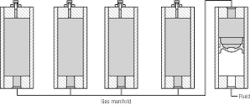
The installation in Figure 4 consists of several gas bottles serving a single piston accumulator through a gas manifold. The accumulator portion must be sized so the piston does not repeatedly strike the caps while cycling. One drawback of this arrangement is that a single seal failure could drain the gas system. Because gas bottles often are less expensive than accumulators, one advantage of this setup might be lower cost.
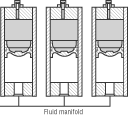
Several accumulators, either piston or bladder design, can be mounted on a hydraulic manifold, Figure 5. If using piston accumulators, the piston with the least friction will move first and occasionally could bottom on the hydraulic cap. In slow or infrequently used systems, this is insignificant.
Gas bottle installations
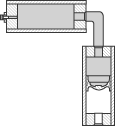
Remote gas storage offers flexibility in large and small systems, Figure 6. The gas bottle concept is generally described with this simple formula: accumulator size minus required fluid output equals gas bottle size. For example, an application that calls for a 30-gal accumulator may only require 8 to 10 gal of fluid output. This application, therefore, could be satisfied with a 10-gal accumulator and a 20-gal gas bottle.
An accumulator used with remote gas storage generally has the same size port at the gas end as at the hydraulic end to allow unimpeded flow of gas to and from the gas bottle. The gas bottle has an equivalent port in one end and a gas charging valve at the other. These two-piece accumulators can be configured or bent at any angle to fit available space.
The gas bottle concept is suitable for either bladder or piston accumulators. Note that bladder accumulators require a special device called a transfer barrier at the gas end to prevent extrusion of the bladder into the gas bottle piping.
Again, a piston accumulator should be sized to prevent piston bottoming at either end of the cycle. Bladder designs should be sized to prevent filling to more than 85% or discharging to more than 85% empty. The flow rate between the bladder transfer barrier and its gas bottle will be restricted by the neck of the transfer barrier tube. Because of these drawbacks, bottle/ bladder accumulators should be reserved for special applications.
Flow rates and response times
Table 2 suggests maximum flow rates for representative accumulator sizes and types. The larger standard bladder designs are limited to 220 gpm, although the rate can be boosted to 600 gpm using an extra-cost, high-flow port. The poppet controls flow rate; excessive flow causes the poppet to close prematurely. Multiple accumulators mounted on a common manifold are needed to achieve flows that are greater than 600 gpm.
bore, in.
capacity
4
6
1 gal
2½ gal
400
800
150
220
-
600
9
12
2,000
3,400
220
220
600
600
Allowable flow rates for piston accumulators generally exceed those for bladder designs. Flow is limited by piston velocity, which should not exceed 10 ft/sec to avoid piston seal damage. In high-speed applications, high seal contact temperatures and rapid decompression of nitrogen that has permeated into the seal material can cause blisters, cracks, and pits in the rubber.
Bladder accumulators respond more quickly to system pressure variations than do piston types for two reasons:
1. Rubber bladders do not have to overcome the static friction which a piston seal must, and 2. The piston mass does not need to be accelerated and decelerated.
In practice, though, the difference in response may not be as great as commonly believed, and is probably insignificant in most applications.
Shock suppression

Tests at the University of Wisconsin, Madison, indicate that shock control does not necessarily demand a bladder accumulator. With system flow at a nominal 30 gpm in the test circuit, Figure 7, an internally piloted directional control valve, 118 ft away from the pump, closes to generate a shock. As the shock wave travels from the valve back through the hydraulic lines and around corners and various restrictions, some portion of its energy is consumed while accelerating the mass of fluid in the lines.
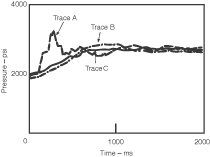
With 1¼-in. tubing, a 2,750-psi relief valve setting, and no accumulator in the circuit, oscilloscope trace A, Figure 8, shows a pressure spike of 385 psi over the relief valve setting. Adding a 1-gal piston accumulator at the valve reduces the transient to 100 psi over relief valve setting, trace B. Substituting a 1-gal bladder accumulator cuts the transient to 78 psi over relief valve setting, trace C, only 22 psi better than the piston-type protection.
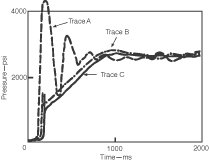
A second, similar test with 5/8-in. tubing and a relief valve setting of 2650 psi results in a pressure spike of 2011 psi over relief valve setting without an accumulator, trace A, Figure 9. A piston accumulator damps the transient to 107 psi over relief valve setting, trace B, while a bladder accumulator damps the transient to 87 psi over relief valve setting, trace C. The difference between accumulator types in shock suppression again was negligible.
Servo equipment
Another common misconception says that all servo applications require a bladder accumulator. Experience shows that only a small percentage of servos require response times of 25 ms or less, the region where the difference in response between piston and bladder accumulators becomes material. Bladder accumulators should be used for applications requiring less than a 25-ms response, and either type when response of 25 ms or greater is adequate.
Setup and maintenance: precharging
On newly repaired bladder accumulators, the shell ID should be lubricated with system fluid before precharging. This fluid acts as a cushion, and lubricates and protects the bladder as it unwinds and unfurls. When precharging begins, the initial 50 psi of nitrogen should be introduced slowly.
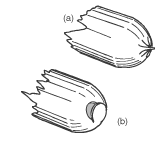
Neglecting these precautions could result in immediate bladder failure. High-pressure nitrogen, expanding rapidly and thus cold, could channel the length of the folded bladder and concentrate at the bottom. The chilled brittle rubber expanding rapidly could rupture in a starburst pattern, Figure 10(a). The bladder also could be forced under the poppet, resulting in a C-shaped cut in the bladder bottom, Figure 10(b).
The fluid side of piston accumulators should be empty during precharging so that gas-side volume is at a maximum. Little damage, if any, can take place during precharging.
Too high a precharge pressure or reducing the minimum system pressure without a corresponding reduction in precharge pressure may cause operating problems or damage to accumulators. With excessive precharge pressure, a piston accumulator will cycle between stages (e) and (b), Figure 2, and the piston will range too close to the hydraulic end cap. The piston could bottom at minimum system pressure to reduce output and eventually cause damage to the piston and its seal. The bottoming of the piston often can be heard; the sound serves as a warning of impending problems.
Too high a precharge in a bladder accumulator can drive the bladder into the poppet assembly when cycling between stages (e) and (b), Figure 2. This could cause fatigue failure of the spring and poppet assembly, or a pinched and cut bladder if the bag gets trapped beneath the poppet as it is forced closed. Too high a precharge pressure is the most common cause of bladder failure.
Too low a precharge pressure or an increase in system pressure without a compensating increase in precharge pressure also can cause operating problems, with possible accumulator damage. With no precharge in a piston accumulator, the piston likely will be driven into the gas end cap and probably will remain there. A single contact is unlikely to cause damage.
For bladder accumulators, too low or no precharge can have severe consequences. The bladder may be crushed into the top of the shell, then may extrude into the gas valve and be punctured. One such cycle is sufficient to destroy a bladder. Piston accumulators, therefore, are more tolerant of improper precharging.