Diving may conjure up images of pleasure-seeking tourists gliding past schools of colorful fish and investigating sunken ships. But diving can be hard work, too. Professional divers are asked to use a variety of tools when repairing underwater structures or working in salvage operations. Hydraulic systems have been employed in underwater activities for a long time. An oil hydraulic power unit is not suitable to be immersed in water for this application, and the length of hose and pressure loss make the limitation of depth around 180 ft. Modifications, such as pressure compensation, are necessary to allow these systems to work at greater depths — but this can also lead to more complicated and potentially unreliable systems.
Using seawater as a pressure medium has obvious advantages in marine applications: elimination of the reservoir and return hoses, reduced equipment size and weight, and the ability to place the hydraulic pump underwater for automatic pressure compensation. This means that the operating depth is unlimited in theory.
The first underwater hydraulic tool system to use seawater was created by the Naval Civil Engineering Laboratory in 1984. Because its seawater hydraulic pump was driven by a diesel engine, the working depth was limited.
Principle of the power pack
Seawater Hydraulics Powered System (SHPS) is an independent project launched at Huazhong University of Science and Technology (HUST), Wuhan, China. SHPS is actually a set of underwater tools driven by a seawater hydraulic power unit (HPU). It is designed to work to a depth of 900 ft. The tools are meant to be operated by divers to accomplish a variety of challenging underwater tasks — cutting wire rope, grinding, brushing, boring, tapping, and wrenching.
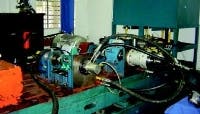
The HPU's seawater pump is driven by an immersible electric motor, specially designed for use in the ocean. Electric power is generated on a support vessel and transmitted to the motor through a waterproof cable. Because the cable must bear the entire weight of the power unit, it is reinforced with synthetic fibers. A combined connection joins the HPU with cable not only to transmit force, but also transmit electric power with a reliable seal to a 900-ft depth.
As a prototype of SHPS, this power unit is set to work at 1450 psi, with a flow rate of approximately 10.5 gpm. It is equipped with only three kinds of tools: a reciprocating wire-rope cutter and two rotating tools, a grinder and a steel wire brush.
SHPS is featured as a totally open circuit, so the HPU and tools can be sunk in the sea, eliminating the need for a reservoir. The pump draws seawater straight from the ocean through a filter unit. No return hoses are necessary because used water drains directly back to the ocean. To ensure high reliability, the power unit consists of as few components as possible. Included in the design is a piston pump, a relief valve to limit pressure, a redundant relief valve for safety, a throttle valve (to adjust flow rate, thus changing the speed of the tools), and accessories.
An accumulator is connected to the outlet of the pump to damp pressure pulsation. Soft tube (with quick connects) is used to join underwater tools with the power unit. All hydraulic components are ocean-pressure compensated to permit use of thin-wall lightweight housing. A ball valve is involved in the circuit to unload system pressure before startup.
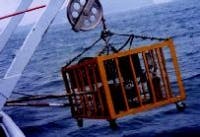
SHPS consists of three main modules: HPU, tools, and the surface support apparatus. Normally, the power unit is mounted and maintained on the deck of a support vessel. A crane hoists the HPU over the gunwale of the support vessel when it is going to be launched for work. The power unit can be lowered into the sea and placed as close to the working spot as possible, reducing the length of tubing between the HPU and the tools, which minimizes pressure loss. This also makes it convenient for a diver to manipulate the power unit.
All hydraulic components in the HPU are water hydraulic components, developed independently at HUST. A filtration unit protects the water hydraulic system from sand, mud, microbes, and any other contamination in the ocean. Multiple layers of stainless steel meshwork are used as a filter medium, to allow reversible flushing.
Experimenting with SHPS
Although divers are now able to work 900 ft below the surface, they need the support of a whole saturation diving system. To verify the power unit under pressure at a 900-ft depth, an unmanned experiment was carried out in a pressure hull of 560 psi, the same pressure as a 1200-ft depth. The HPU was adjusted to work at 1450 psi. Results show that the power unit can operate in this type of environment with all components bearing full load.
Practical experiments of SHPS were held both in the laboratory and on the bottom of South China Sea. All components were tested and verified separately in the laboratory. The experiment in the South China Sea was carried out 90 ft below the surface. Two divers manipulated the power unit and tools to accomplish two kinds of underwater jobs (cutting wire rope and grinding a metallic structure).
Lessons learned
The accumulator is effective at absorbing vibration and noise in the power pack, which prolongs the lifespan of hydraulic components, especially the relief valve.
The aperture of the filter mesh-work should be carefully selected to prevent premature filter failure. The filter aperture of 10 µm, tested in the laboratory, is not suitable for open circuit. Somewhere in the range of 30 µm would be a good compromise.
Pressure unloading is important, not only at startup, but when the quick-acting couplings need to be disconnected to change tools.
As far as future changes, the following should be considered:
- a self-renewing filter system should be developed to ensure a longer mean time between failure for the filter
- more styles of tools need to be developed, to extend the purpose of the power pack, and
- all hydraulic components need more experimentation, to ensure higher reliability.
Yu Zu-Yao, He Xiao-Feng, Nie Song-Lin, and Li Zhuang-Yun are with the School of Mechanical Science & Engineering at Huazhong University of Science & Technology in Wuhan, China. Email Zu-Yao at yuzuyao@ 163.com. This discussion is adapted from a paper given at the ICFP 2005 conference held in Hangzhou, China (http://sklofp.zju.edu.cn/icfp).