An automotive company built an assembly plant on land that had a limestone base. Research found that if the limestone was removed, crushed and re-laid, the plant stability and harmonics would be improved to a point that would offset the cost of crushing the limestone.
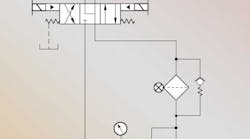
They used a large rock crusher that had a fairly simple hydraulic circuit, as pictured. Two Caterpillar front end loaders would dump large chunks of broken limestone into a chute from either side of the rock crusher. A mechanical vibrator would move the limestone down to a large rotating drum with 50 to 60 swinging hammers that would pulverize the limestone into stones no larger than a tennis ball. The crushed stone would then be laid back into the ground to build the base for the new plant.
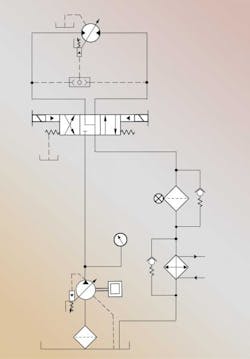
The problem they were experiencing was overheating of the hydraulic oil, which caused the over-temperature sensor to shut the unit down. It could be up to an hour before the system would cool down and reset the sensor.
We were asked to investigate and fix the problem. The customer was sure it needed a larger fan-cooled heat exchanger. We watched the operation for a couple of hours and noticed that the overheating shut down occurred shortly after the crusher drum was stopped or allowed to free wheel for more than 20 to 30 minutes.
Any idea what could have been causing the problem? Can you think of a simple fix?
Robert J. Sheaf, Jr. is the founder of Certified Fluid Consultants (CFC) and President of CFC-Solar Inc. CFC-Solar provides technical training, consulting, and field services to any industry using fluid power technology. Visit www.cfc-solar.com for more information.
|
Find the solution Think you know the answer? Submit solutions to [email protected]. The correct answer will also be published in the next edition of “Troubleshooting Challenge.” Congratulations go out to Chris Goodlet, CFPS, of Prodomax Automation Inc., who was the winner of our April Troubleshooting Challenge. All correct solutions will be entered for a chance at a $50 gift card — we will randomly select a winner from all correct answers. The winner’s name will be printed in the next edition of “Troubleshooting Challenge.” |
|
Solution to April’s stretching machine problem The circuit design on the 300-hp power unit for the stainless steel stretching machine had a design flaw that caused both of the large volume pumps to rupture. When the system was started up, the large vane pumps primed quickly while the piston pumps lagged behind. It was later determined that the piston pump cases were not prefilled with system oil, making it even more difficult for them to prime. The vane pump unloading valves were piloted open from the piston pump’s pressure. The redesign involved moving the signal (pilot) line to the outlet side of the piston pump. This will allow the vane pump pressure to open the unloading valve, which will act as a relief, until the piston pumps develop pressure. This was a very expensive lesson to learn and to think of the potential harm it could have caused. |